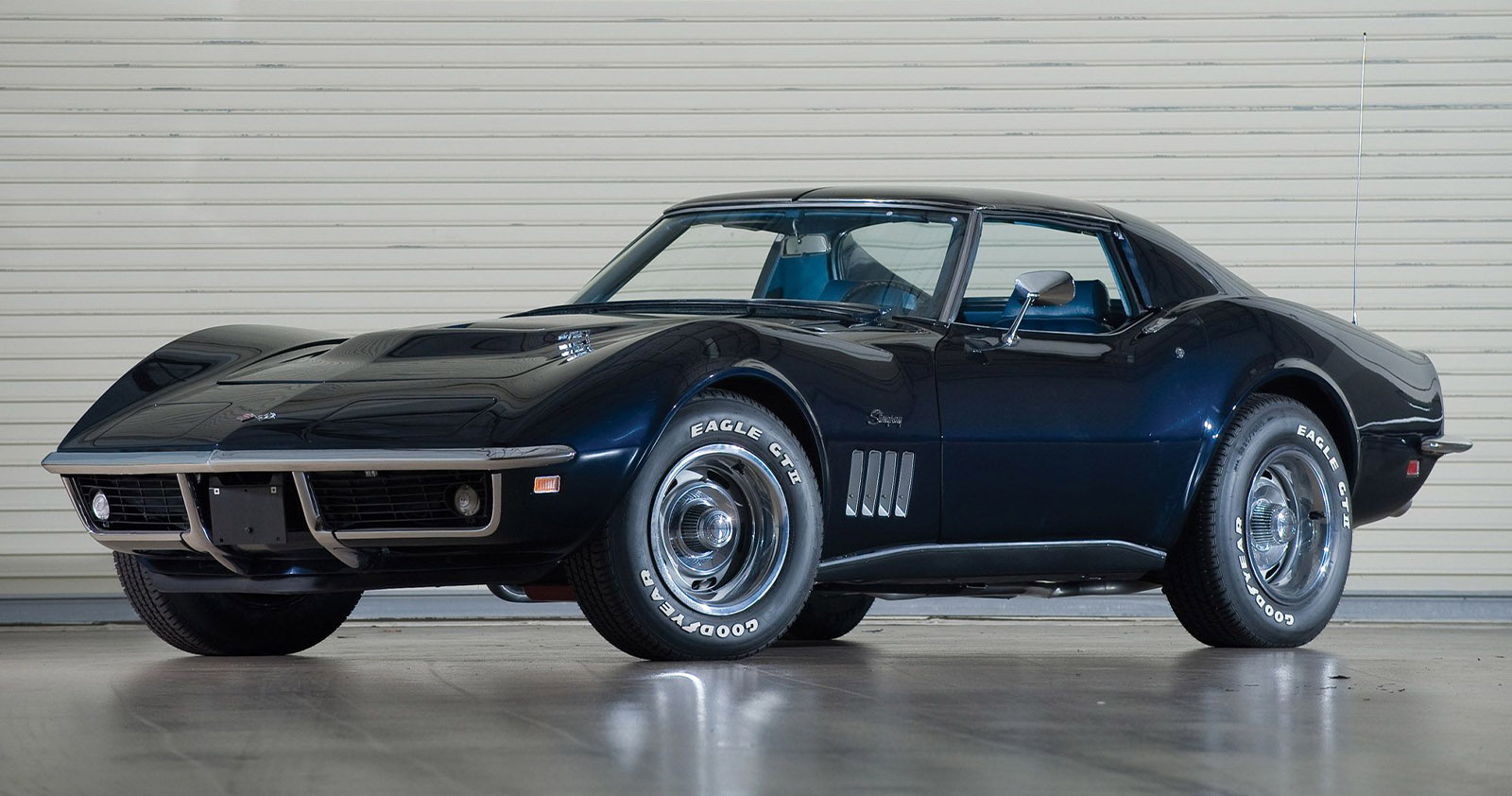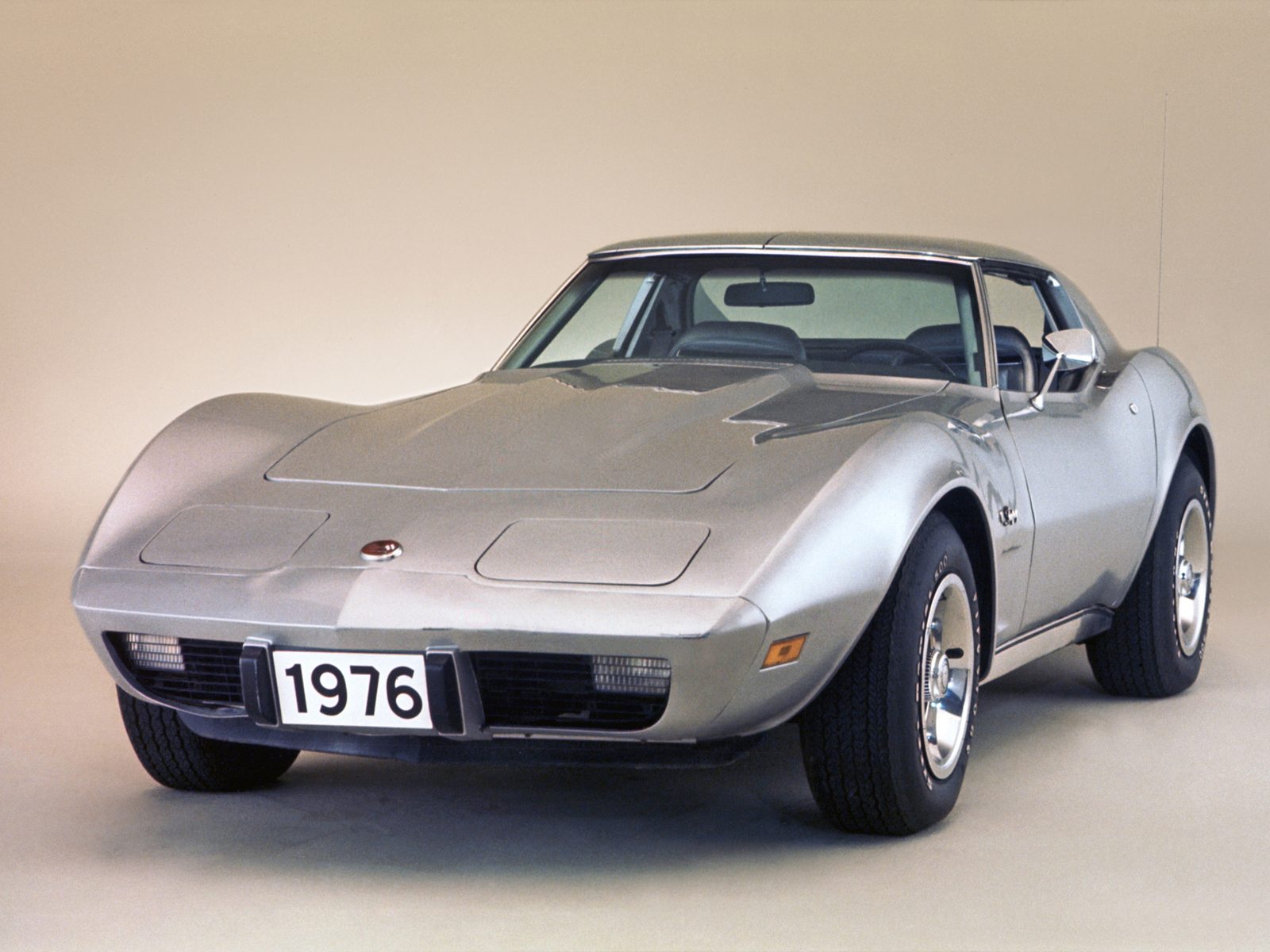
C3 CORVETTE - 1976
The 1976 Corvette
Coupe only for the first time, the Stingray badge for the last, aluminum wheels back after three years, a steel floor over the catalyst and a steering wheel borrowed from the Vega. Horsepower edged up to 180 and 210, and a record 46,558 were built.
Quick Nav: Story · Price & Options · VIN · Specs · Technical · Pics & Videos · The Market · All · FAQs
The Basics
Model & Gen: 1976 Corvette (C3)
Body Type: Sport Coupe (T-top) only; no convertible
VIN: 1Z37L6S400001 – 1Z37L6S446558
Original Price: $7,604.85
Colors: 10 (Classic White, Silver, Bright Blue, Dark Green, Mahogany, Bright Yellow, Buckskin, Dark Brown, Orange Flame, Red)
Engine: 350 ci V-8 only: 180 hp (L48) or 210 hp (L82, not sold in California); last year of the Stingray badge
Transmission: 4-speed standard (M20 wide or M21 close ratio at no charge; manuals not sold in California); 3-speed Turbo Hydra-Matic (M40, TH350 behind the L48, TH400 behind the L82) at no charge, in 79 percent of cars
Units Produced: 46,558
The Overview
The 1976 Corvette is the first with no convertible and the last with Stingray on its fenders, and in between it is the 1975 cleaned up. The rear-deck grilles went with the Astro Ventilation system they had served, the cowl-induction flap that whistled on the 1973–75 hood went too, replaced by a duct that drew air from above the radiator (the hood grille stayed for one more year), and the rear ‘CORVETTE’ letters changed from the wide 1975 style to small recessed ones part-way through the run, so both are correct. A partial steel floor pan went in as a heat shield over the catalytic converter and stiffened the structure, the lighter Delco Freedom battery became standard, and so, from mid-year, did power steering and power brakes; 173 early cars left without power steering.
The interior got the change nobody wanted: a four-spoke sport steering wheel shared with the Vega GT, which lasted exactly one year. The aluminum wheels came back after their 1973 recall, now a set of four Kelsey-Hayes castings made in Mexico for $299 with a steel spare, and 6,253 buyers took them. Horsepower moved the right way for the first time since 1969: the L48 to 180 and the L82 to 210, helped by the new induction. California buyers could not have the L82 or a manual transmission, and the automatic behind the L48 was now the lighter TH350 rather than the TH400, which stayed behind the L82. The Z07 package disappeared and the Gymkhana suspension went to $35.
The price rose to $7,604.85, and a fully optioned car passed $10,000 for the first time, yet 46,558 were built, breaking the 1969 record by nearly 8,000 with the automatic in 79 percent, air conditioning in 88 percent and the custom interior in 79 percent. With most other American performance cars gone, the Corvette was the only one left to buy. In the market the 1976 sits with the 1975 and 1977 at the bottom of the C3 but a little above both: the last Stingray, the first aluminum wheels, and a four-speed L82 with FE7 is a tidy driver’s car for small money.
The 1976 Corvette Story
By 1976, the United States economy was on the mend from the 1973–1975 global economic recession. The recession, which had been caused in part by the 1973 oil crisis, had caused gas prices to soar which, in turn, had made automotive manufacturers begin re-evaluating the types of vehicles they were manufacturing.
It had led to the end of the big-block engine era for Chevrolet, and had further influenced the decision being made by automotive manufacturers everywhere to increase fuel economy at all costs – even if it meant a loss in horsepower as a result. However bad the prognosis had looked just a year earlier, 1976 had seen Jimmy Carter elected president and, with him, the promise of an economic stimulus package that would re-strengthen a diminished economy.
Despite the economic hardships felt around the world, the 1976 Stingray had arrived on the heels of one of Corvette's most successful sales years ever. The commercial success of the 1975 Corvette coupe (but not the convertible) had strengthened Chevrolet's resolve to do away with the roadster option and focus solely on producing the best edition of their popular sports car possible. It was a gamble that would prove to pay off.
Stylistically, the 1976 Corvette was the best looking of the C3 Corvettes to date. While the changes to the exterior were minor, they were significant from an aesthetics standpoint.
To start, the air-extractor vents were removed from the rear deck. These vents, which had been part of the C3 Corvette since 1968 (they served as the exhaust mechanism for Corvette's Astro-Ventilation system) were eliminated along with the ventilation system itself.
Similarly, the 1976 Corvette's hood no longer featured a cowl flap. The former hood's cowl flap had become the center of consumer complaints which stated that the assembly whistled loudly during vehicle operation.
In place of the cowl flap, a simpler system was developed that rammed in airflow through a duct that ran forward over the radiator support to pick up some of the outside air that fed the radiator.
Even though the cowl-induction system had been eliminated for 1976, the intake grille remained for another year, and would not be deleted until 1977.
Moving to the rear of the Corvette, Chevrolet introduced two different styles of rear bumper/fascia assemblies. The first fascia was actually a carryover from the 1975 model year and featured the word CORVETTE in a large font that filled the width of the surface area between the taillights. The second, which was introduced in 1976, featured the word “CORVETTE” in smaller, recessed letters.
Perhaps the most notable change for 1976 was the re-introduction of the aluminum wheels that had first been introduced in 1973. Listed as option RPO YJ8, the set of four aluminum wheels (the 1973 option had included a fifth full-size wheel as a spare) sold at an additional cost of $299.00 for the set, and included a conventional steel spare wheel/tire assembly. The wheels were manufactured by Kelsey Hayes in Mexico and could be identified by the source and build location information etched on their inside surface.
The interiors of the 1976 Corvette were largely unchanged from the previous year with one notable exception. The interior now featured a four-spoke, “sport” steering wheel, though it was an option not well received by Corvette enthusiasts due mostly to the fact that the new steering wheel was the same as those being installed on the subcompact Chevy Vega GT, along with a number of other Chevrolet models that year.
Beneath the car, a partial steel subsection was added to the forward body structure. This steel under pan was added in an effort to increase the car's rigidity and to act as a heat shield/insulator between the Corvette's catalytic converters and the vehicle cockpit. While the catalytic converter was a concern to some engineers, it was actually a benefit to others. As a result of the catalytic converter being installed, the horsepower rating of the 1976 Corvette actually increased slightly.
The L48 engine saw an increase of 15 horses, pushing its total horsepower to 180 bhp. The L82 increased to 210 bhp. Unfortunately, the L82 engine was not offered in California in 1976 (and 1977) because it did not meet the state's tougher emissions standards. Four-speed manual transmissions were also banned out west for those same model years.
Interestingly, an automatic transmission was the only option available to Californians in 1976 (and 1977). However, it wasn't the Turbo Hydra-Matic 400 that had been previously used behind all Corvette engines. Instead, Chevrolet mandated use of the less robust TH 350 automatic transmission. This choice was made because product planners felt that using the more expensive 400 transmission was overkill, especially given the limited amount of power that the L48 engine produced. The TH 400 remained the transmission of choice whenever a Corvette equipped with the L82 was ordered with an automatic transmission.
Elsewhere, there were other mechanical revisions to the C3 that also helped improve performance, helped reduce weight and further helped the horsepower boost experienced on the 1976 Corvette.
Power steering and power brakes became standard on all 1976 Corvettes midway through production (though 173 early-production Corvettes hit the streets without power steering). Chevrolet introduced a lighter (by approximately 13 pounds) Delco Freedom battery as a standard piece of equipment.
The Corvette also featured the aforementioned modified cowl induction, which was as much a functional benefit to the car's overall performance as it was an aesthetic revision to the Corvette's hood. Since it pulled air through an intake that was located in front of and above the radiator instead of at a more restrictive cowl located near the windshield, the 1976 Corvette could now breathe more easily.
Production Volumes
Unfortunately for consumers, Corvette's price had risen again for 1976. It had increased over the previous model years because of the sharp inflation that had plagued consumers since the start of the global energy crisis in 1973. In 1976, consumers could purchase a base coupe (without any options) for $7,604.85. However, if the car were purchased with a full complement of options (as many were), it was possible to spend more than 10 grand (including ancillary charges) for the first time in Corvette's history.
Still, although the price of the Corvette was at an all-time high, the new Corvette was still in high demand, as reflected in the fact that Chevrolet sold 46,558 units that year, breaking the previous sales record set in 1969.
It has been debated that this continued increase in Corvette sales in 1976 was a direct result of the energy crisis earlier in the decade. Many automotive manufacturers had eliminated their performance-car production lines completely, forcing consumers to turn to Chevrolet and the 1976 Corvette as a result. While some critics have speculated that this was the primary reason for the Corvette's sales strength that year, there was still no denying that the Corvette was a unique and satisfying sports car – even at the higher price point.

 The 1976 Corvette interior included the custom interior trim as a standard feature. It also introduced a new four-spoke, "sport" steering wheel.
 The 1976 Chevy Aerovette almost went to production in 1980 before David R. McLellan made the decision to move forward with a more conventional front-engine/rear-axle platform.
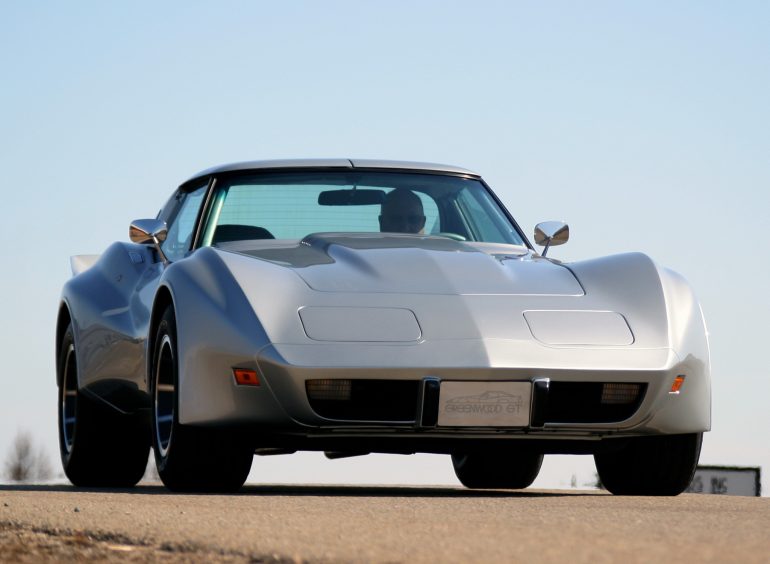
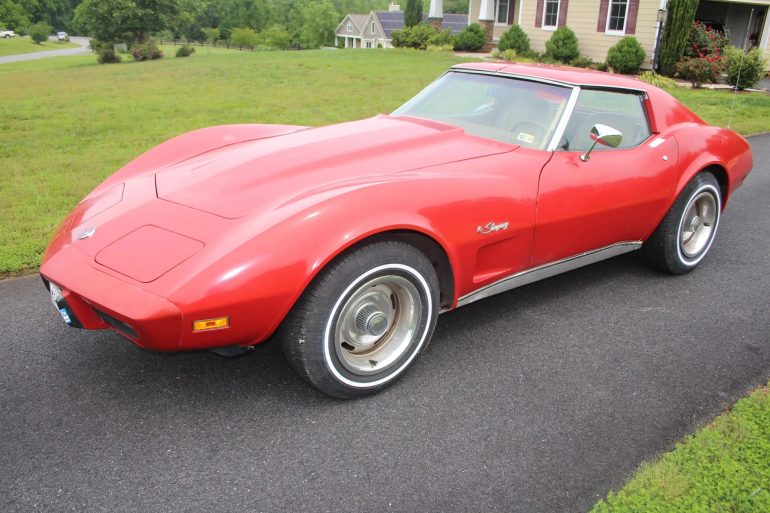
 1976 Corvette Brochure Cover
The 1976 Corvette’s four-spoke steering wheel was the same part Chevrolet put in the Vega GT, and buyers of a $7,600 sports car noticed. It lasted one year. The aluminum wheels that returned the same year, cast by Kelsey-Hayes in Mexico, lasted through 1982 and are now the wheels most C3 owners want.
DID YOU KNOW
Price & Options
Core Features & Factory Options
The Sport Coupe, the only body, listed at $7,604.85, up $795 on 1975, with radial tires, the alarm, Positraction and the four-speed or Turbo Hydra-Matic included; power steering and power brakes were added to the standard equipment during the year, so RPO N41 ($151.00) is recorded on 46,385 cars and J50 ($59.00) on all 46,558. The engine list was two long: the 210-hp L82 at $481.00 went into 5,720 cars, leaving about 40,838 with the 180-hp L48.
The Turbo Hydra-Matic went into 36,625 cars, 79 percent, the close-ratio M21 into 2,088 and the standard M20 into about 7,845. The Gymkhana suspension (RPO FE7, now $35.00) went into 5,368 cars, the optional axle ratio (RPO ZQ1, $13.00) into 1,371 and the California emission test (RPO YF5, now $50.00) into 3,527, all of them automatics with the L48.
Air conditioning (RPO C60, $523.00) reached 40,787 cars, 88 percent, the tilt-telescopic column (RPO N37, $95.00) 41,797, power windows (RPO A31, $107.00) 38,700 and the custom interior ($164.00) 36,762, 79 percent, with buckskin leather on 8,946 cars, Dark Firethorn on 8,259, black on 7,826 and dark brown on 6,184. The stereo (RPO U58, $281.00) went into 34,272 cars against 11,083 AM/FM radios (RPO U69, $187.00); the map light (RPO UF1, $10.00) into 35,361, the heavy-duty battery (RPO UA1, $16.00) into 25,909 and the electric rear defogger (RPO C49, $78.00) into 24,960.
Raised-white-letter radials (RPO QRZ, $51.00) went on 39,923 cars against 3,992 white-stripes (RPO QRM, $37.00), and the returning cast aluminum wheels (RPO YJ8, $299.00) onto 6,253. Ten colors were offered; the totals add up to 46,549, nine short of production, and the last VIN is documented as 446567.
MORE: PRICING, OPTIONS & COLORS / RPO CODES
| CODE | DESCRIPTION | QUANTITY | RETAIL PRICE |
|---|---|---|---|
| 1YZ37 | Base Corvette Sport Coupe | 46,558 | $7,604.85 |
| A31 | Power Windows | 38,700 | $107.00 |
| C49 | Rear Window Defogger (electric) | 24,960 | $78.00 |
| C60 | Air Conditioning | 40,787 | $523.00 |
| FE7 | Gymkhana Suspension (heavy-duty springs and shocks) | 5,368 | $35.00 |
| J50 | Power Brakes (standard from mid-year) | 46,558 | $59.00 |
| L82 | 350ci, 210HP Engine (not available in California) | 5,720 | $481.00 |
| M21 | 4-Speed Manual Transmission, Close Ratio | 2,088 | no charge |
| M40 | Turbo Hydra-Matic 3-Speed Automatic | 36,625 | no charge |
| N37 | Tilt-Telescopic Steering Column | 41,797 | $95.00 |
| N41 | Power Steering (standard from mid-year; 173 cars built without) | 46,385 | $151.00 |
| QRM | White Stripe Steel-Belted Radial Tires, GR70x15 | 3,992 | $37.00 |
| QRZ | White Letter Steel-Belted Radial Tires, GR70x15 | 39,923 | $51.00 |
| U58 | AM-FM Radio, Stereo | 34,272 | $281.00 |
| U69 | AM-FM Radio | 11,083 | $187.00 |
| UA1 | Heavy Duty Battery | 25,909 | $16.00 |
| UF1 | Map Light on Rearview Mirror | 35,361 | $10.00 |
| YF5 | California Emission Test | 3,527 | $50.00 |
| YJ8 | Cast Aluminum Wheels (set of 4, steel spare) | 6,253 | $299.00 |
| ZQ1 | Optional Rear Axle Ratio | 1,371 | $13.00 |
| – | Custom Interior Trim (leather seats, cut-pile carpet, wood-grain trim) | 36,762 | $164.00 |
| CODE | EXTERIOR | TOTAL | INTERIOR |
|---|---|---|---|
| 10 | Classic White | 10,674 | Black, Blue-Green, Buckskin, Dark Brown, Dark Firethorn, Smoked Gray, White |
| 13 | Silver | 6,934 | Black, Blue-Green, Buckskin, Dark Firethorn, Smoked Gray, White |
| 72 | Red | 4,590 | Black, Buckskin, Dark Firethorn, Smoked Gray, White |
| 69 | Dark Brown | 4,447 | Black, Buckskin, Dark Brown, White |
| 37 | Mahogany | 4,182 | Black, Buckskin, Dark Firethorn, Smoked Gray, White |
| 70 | Orange Flame | 4,073 | Black, Buckskin, Dark Brown |
| 56 | Bright Yellow | 3,389 | Black, Dark Brown |
| 22 | Bright Blue | 3,268 | Black, Smoked Gray |
| 64 | Buckskin | 2,954 | Black, Buckskin, Dark Brown |
| 33 | Dark Green | 2,038 | Black, Blue-Green, Buckskin, Smoked Gray, White |
Specifications & Performance
Engine & Transmission
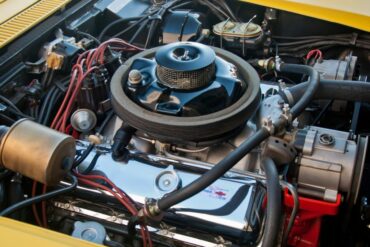
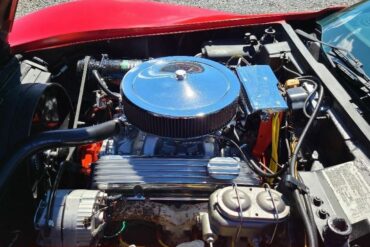
Both 350s gained power for 1976 through better breathing: the base L48, still 8.5:1, went to 180 hp net at 4,000 rpm and 270 lb-ft at 2,400, and the L82, with its forged crank, four-bolt mains and performance cam at 9.0:1, to 210 hp at 5,200 rpm and 255 lb-ft.
The cowl-induction flap was gone; air came through a duct running forward over the radiator support to an inlet above the radiator, which fed the Quadrajet more freely than the old cowl path and stopped the whistle. Both engines ran HEI ignition, a single catalytic converter and unleaded fuel.
The L82 and every manual gearbox failed California certification, so Californians got an L48 with the automatic; and that automatic was now the lighter TH350 behind the L48, with the TH400 reserved for the L82. Road & Track’s L82 four-speed did 0–60 in 7.4 seconds and the quarter in 15.2.
The chassis carried over with a partial steel floor pan bolted in over the exhaust as a heat shield, which also stiffened the forward structure, and with power steering and power brakes made standard during the year. The Gymkhana suspension (RPO FE7, $35.00) with stiffer springs and shocks went under 5,368 cars; the Z07 brake-and-bar package was dropped.
The aluminum wheels returned as RPO YJ8, four Kelsey-Hayes castings in the 1973 pattern at 15 x 8 inches, eight pounds lighter apiece than the steel Rally wheels, with a steel spare and the source and plant etched inside the rim; 6,253 sets were sold. The GR70-15 radials, four-wheel discs and 98-inch wheelbase were unchanged, and weight passed 3,500 lb.
MORE: FULL SPECIFICATIONS / ENGINE
| SPEC | 1976 CORVETTE |
|---|---|
| Engines | 350 ci (5.7 L) small-block V-8 in two versions, hydraulic lifters, catalytic converter, unleaded fuel, SAE net ratings; the L82 and all manual transmissions were not certified for California |
| Base engine (L48) | 350/180 hp net @ 4,000 rpm, 270 lb-ft @ 2,400 rpm, 8.5:1, hydraulic lifters, Rochester Quadrajet, HEI ignition, induction from a duct over the radiator in place of the cowl flap; about 40,838 cars; up 15 hp on 1975 |
| RPO L82 | 350/210 hp net @ 5,200 rpm, 255 lb-ft @ 3,600 rpm, 9.0:1, hydraulic lifters, forged crank, four-bolt mains, high-performance camshaft, Quadrajet, finned aluminum valve covers; 5,720 cars, $481.00; 49-state only |
| RPO FE7 | Gymkhana suspension: higher-rate springs and firmer shocks; 5,368 cars, $35.00; the Z07 package was dropped |
| Transmission | 4-speed standard: wide-ratio M20 (about 7,845 cars) or close-ratio M21 (2,088) at no charge, 49-state only; 3-speed Turbo Hydra-Matic (RPO M40) at no charge in 36,625 cars, 79 percent, as the lighter TH350 behind the L48 and the TH400 behind the L82 |
| Axle ratio | 3.36:1 standard with manuals, 3.08:1 with Turbo Hydra-Matic; Positraction standard; optional ratios (RPO ZQ1, $13.00) on 1,371 cars |
| Front suspension | Independent; short-long arm, coil springs, anti-roll bar; FE7 heavy-duty |
| Rear suspension | Independent; frame-mounted differential, half-shafts, trailing arms, nine-leaf transverse spring; FE7 heavy-duty |
| Brakes | Four-wheel disc, 11.75-in rotors, four-piston calipers, dual-circuit master cylinder; power assist standard from mid-year (RPO J50, $59.00, on all 46,558 cars) |
| Steering | Saginaw recirculating ball, 16.0:1; four-spoke sport steering wheel shared with the Vega GT (1976 only); tilt-telescopic column (RPO N37, $95.00; 41,797 cars); power steering standard from mid-year (RPO N41, $151.00; 46,385 cars, 173 built without) |
| Body | Rear-deck Astro Ventilation grilles removed; cowl-induction flap removed (the hood grille stayed one more year); two rear ‘CORVETTE’ emblem styles during the year; partial steel floor pan as a heat shield over the catalytic converter; Delco Freedom battery; last year of the Stingray fender script |
| Wheels & tires | 15 x 8 in slotted steel Rally wheels with trim rings and caps, or 15 x 8 cast aluminum wheels by Kelsey-Hayes (RPO YJ8, $299.00; 6,253 cars, with a steel spare); GR70 x 15 steel-belted radials, raised-white-letter (RPO QRZ, 39,923 cars) or white-stripe (RPO QRM, 3,992) |
| Fuel tank | 17 gal; unleaded fuel only |
| Wheelbase | 98 in |
| Overall length / width / height | 185.2 in / 69.0 in / 48.0 in |
| Track, front / rear | 58.7 in / 59.5 in |
| Curb weight | approx. 3,540 lb |
| 0–60 mph | 7.4 sec (L82 four-speed, Road & Track); approx. 8.5 sec (L48 automatic) |
| Quarter mile | 15.2 sec (L82, Road & Track); approx. 16.5 sec (L48) |
| Top speed | approx. 125 mph (L82); 118 mph (L48) |
| Production | 46,558 coupes, a record that stood until 1977; the first year without a convertible since 1953 |
| Assembly | St. Louis, Missouri; engines from Flint |
Vehicle Identification Numbers (VIN)
46,558 Cars, 1Z37L6S400001 TO 1Z37L6S446558
The 1976 Corvette carries a thirteen-character VIN: 1Z37L6S for the base coupe and 1Z37X6S for the L82, followed by a sequence number from 400001 to 446558; the last car built is documented as 446567, nine beyond the published total of 46,558. The 1 is Chevrolet, Z the Corvette series, 37 the coupe body (the only one), the fifth character the engine (L for the 180-hp L48, X for the L82), 6 the model year and S the St. Louis plant. The VIN plate is on the left front hinge pillar, with the trim tag on the same pillar carrying the body build date, the trim code and the paint code; the number is stamped on the frame and as a partial VIN on the engine and transmission.
The engine pad on the right front of the block carries the Flint V prefix, the build date and a suffix: CKW and CKX for the L48 with four-speed and automatic (CLS California automatic), CHC and CKC for the L82 with four-speed and automatic. Both engines are casting 3970010 with 333882 heads and run Quadrajets numbered 17056xxx. The VIN engine letter, the pad suffix and the casting dates should agree, the distributor should be an HEI unit, and the transmission, axle and distributor should all be dated before the build date.
MORE: VIN DECODER / PRODUCTION
| POSITION | MEANING |
|---|---|
| 1 (First Digit) | Manufacturer: 1 = Chevrolet |
| Z (Second Digit) | Series: Z = Corvette |
| 37 (Third & Fourth Digits) | Body: 37 = Sport Coupe (the only body) |
| L / X (Fifth Digit) | Engine: L = 350/180 L48, X = 350/210 L82 |
| 6 (Sixth Digit) | Model year: 6 = 1976 |
| S (Seventh Digit) | Assembly plant: S = St. Louis, Missouri |
| 400001–446558 (Eighth through Thirteenth Digits) | Production sequence number; the last car is documented as 446567, nine past the published total |




Pictures, Videos, Wallpapers & Galleries
Ten colors, with Classic White on nearly one car in four: Classic White (10,674), Silver (6,934), Red (4,590), Dark Brown (4,447), Mahogany (4,182), Orange Flame (4,073), Bright Yellow (3,389), Bright Blue (3,268), Buckskin (2,954) and Dark Green (2,038), with seven interior colors; the color totals account for every car but nine.


Market & Buying Guide
For Sale & What They Bring
The 1976 shares the bottom of the C3 market with the 1975 and 1977, with a few points in its favor: the last Stingray script, the first of the aluminum wheels, 15 more horsepower than 1975, and no convertible to pull money away from the coupes. The order is L82 four-speeds with the Gymkhana suspension and aluminum wheels first, then L82 automatics, then the 40,000-odd L48s that most cars are, with original paint and interior counting for more than mileage. A clean L48 automatic with air and the custom interior is the entry ticket to C3 ownership; the Vega steering wheel is usually the first thing a new owner replaces, and a car that still has it gets a nod from the judges.
Results tracked by Classic.com from October 2025 through October 2026: an original L82 four-speed sold for $19,000 on Bring a Trailer in February 2026 and a modified L82 automatic for $17,250 at Cars & Bids in January; original automatics sold for $16,500 and $10,950 on Bring a Trailer, $12,500 at GAA and as little as $6,600 at Mecum Kissimmee, while a modified Stingray made $25,000 at GAA in February 2026 and a custom was bid to $9,000 at Hemmings and a modified car to $14,100 at Cars & Bids without selling. Dealers’ last asking prices on cars that sold or were withdrawn ran $12,995 to $24,997. In autumn 2026 original coupes were offered at $16,500 to $26,900, an L82 four-speed at $26,000, modified cars at $18,500 to $26,220 and customs and restomods at $19,995 to $66,000. Check whether a result includes the buyer’s premium (Mecum and Barrett-Jackson results do, Bring a Trailer bids do not), and treat asking prices and unsold high bids separately from completed sales.
Verification is simple: the fifth VIN character is X on an L82 and L on a base car, so an L82 with an L in the VIN is a dress-up, and California cars (RPO YF5) are always L48 automatics. The engine pad should carry a V prefix and CHC or CKC on a 3970010 block with the partial VIN matching the car for an L82, CKW, CKX or CLS for an L48, and the distributor should be the HEI unit. Original YJ8 wheels carry Kelsey-Hayes and Mexico markings inside the rim; reproductions and later GM wheels are common and worth less. A 1976 should have no rear-deck grilles and no cowl flap under the hood grille, and either rear emblem style is correct; the Vega steering wheel and the steel floor pan are the other year markers.
The C3 body sits on the C2’s birdcage and rusts in the same places: the windshield frame, the door hinge pillars, the frame kickups over the rear wheels and around the trailing-arm mounts, and the lower doors behind the steel beams; the 1976 adds the steel floor pan, which rusts where carpet holds water. The urethane covers at both ends crack and sag as the mounting hardware corrodes, the headlights still run on vacuum, which leaks at the actuators and check valves until nothing works, and the original catalytic converter is often long gone. The T-top seals are the usual leak. Trailing-arm bushings, half-shaft U-joints and the four-piston calipers (weeping unless sleeved) are the usual mechanical work, and the HEI, unleaded-fuel engine is easy to live with on modern gasoline. Budget for the bumper covers, the vacuum system, seals and brakes on any 1976 that has sat.
MORE: THE MARKET
Everything We've Published On The 1976 Corvette
Get all the latest news stories, upcoming auctions, prices, videos and more about the 1976 Chevrolet Corvette! The latest headlines here.


FAQs
How many 1976 Corvettes were built?
Chevrolet built 46,558 Corvettes for 1976 at St. Louis, Missouri, all T-top coupes, a new record that beat 1969 by nearly 8,000 and stood only until 1977. Of those, 5,720 had the L82, 36,625 the Turbo Hydra-Matic, 40,787 air conditioning, 36,762 the custom interior, 6,253 the returning aluminum wheels and 5,368 the Gymkhana suspension. The last VIN is documented as 446567, nine past the published total.
How much is a 1976 Corvette worth today?
In late 2025 and 2026, original 1976 Corvettes sold for $6,600 to $19,000 at auction, the top figure an L82 four-speed on Bring a Trailer, and modified cars for $14,100 to $25,000. Dealers asked $16,500 to $26,900 for original coupes, $26,000 for an L82 four-speed and $19,995 to $66,000 for customs and restomods. The 1976 is one of the least expensive Corvettes, priced a little above the 1975 and 1977 as the last Stingray.
What engines did the 1976 Corvette have?
Two 350 small blocks, both hydraulic-lifter with a catalytic converter and unleaded fuel: the L48 at 180 hp, up 15 on 1975, and the L82 at 210 hp. The L82 and all four-speed transmissions were not certified for California, where every 1976 Corvette was an L48 automatic. The automatic was the lighter TH350 behind the L48 and the TH400 behind the L82, and it went into 79 percent of cars. Induction now came from a duct above the radiator instead of the cowl flap.
What colors did the 1976 Corvette come in?
Ten: Classic White (10,674 cars), Silver (6,934), Red (4,590), Dark Brown (4,447), Mahogany (4,182), Orange Flame (4,073), Bright Yellow (3,389), Bright Blue (3,268), Buckskin (2,954) and Dark Green (2,038). Interiors came in black, white, buckskin and dark firethorn vinyl and black, white, smoked gray, blue-green, buckskin, dark brown and dark firethorn leather in the custom interior, which 79 percent of buyers chose.
How much did the 1976 Corvette cost when new?
The Sport Coupe was $7,604.85, with radial tires, the alarm, Positraction, the four-speed or Turbo Hydra-Matic and, from mid-year, power steering and brakes included. The L82 added $481.00, the aluminum wheels $299.00 and the Gymkhana suspension $35.00; air conditioning was $523.00, the custom interior $164.00, power windows $107.00, the tilt-telescopic column $95.00, the AM/FM radio $187.00 and the stereo $281.00. A typical automatic, air-conditioned L48 with the custom interior, power windows, tilt column and stereo came to about $8,780, and a loaded L82 with aluminum wheels passed $9,500, the first Corvette to approach $10,000 out the door.
What changed on the 1976 Corvette?
The convertible was gone, leaving the coupe alone for the first time. The rear-deck vents and Astro Ventilation were dropped, the cowl-induction flap gave way to a duct above the radiator, the rear emblem changed mid-year, a steel floor pan went in over the catalytic converter, the Delco Freedom battery and, from mid-year, power steering and brakes became standard, and the Vega GT’s four-spoke steering wheel appeared for one year. The L48 rose to 180 hp and the L82 to 210, the aluminum wheels returned as RPO YJ8, and the Z07 package was dropped. It was the last year for the Stingray name until 2014.
Was 1976 the last Stingray?
The last of the originals. The Stingray script appeared on the front fenders from 1969 through 1976 (the 1963–67 cars were Sting Rays, two words, and the 1968 had no name at all), and Chevrolet dropped it for 1977, so the 1976 is the last C3 to wear it. The name came back as a model designation on the 2014 C7 and the 2020 C8, which is why the 1976 is sometimes called the last Stingray Corvette of the first era.
All The Research
1976 Corvette Advertisements / 1976 Corvette Colors / 1976 Corvette Engine / 1976 Corvette Factory Options / 1976 Corvette For Sale / 1976 Corvette Maintenance / 1976 Corvette Mods / 1976 Corvette Owners Manual / 1976 Corvette Performance / 1976 Corvette Posters / 1976 Corvette Pricing / 1976 Corvette Production / 1976 Corvette Recalls / 1976 Corvette Research / 1976 Corvette RPO Codes / 1976 Corvette Sales Brochures / 1976 Corvette Specifications / 1976 Corvette Technical Research / 1976 Corvette Service Bulletins / 1976 Corvette VIN Numbers